Hidden Water Leak Detection in Freehold Township, NJ
When pipes fail inside enclosed walls, finished ceilings, or subfloors, professional water leak detection Freehold Township NJ provides immediate answers. We locate concealed leaks non-invasively before moisture destroys structural framing.
The Threat of Concealed Wall and Ceiling Pipe Leaks
Concealed piping runs throughout modern homes, supplying bathrooms, kitchens, and upstairs laundry rooms. When a leak behind wall Freehold Township properties develops, water can travel several feet along wooden studs and joists before surfacing. In neighborhoods along the Route 537 corridor and throughout West Freehold, two-story colonial homes frequently experience leaks originating from second-floor supply lines that only reveal themselves as water stains on first-floor ceilings.
Another classic indicator is experiencing an unexpected high water bill leak Freehold Township NJ homeowners find unexplainable. Even a hairline pinhole leak losing just two gallons of water per minute wastes tens of thousands of gallons in a single billing cycle while silently saturating insulation and structural timber.
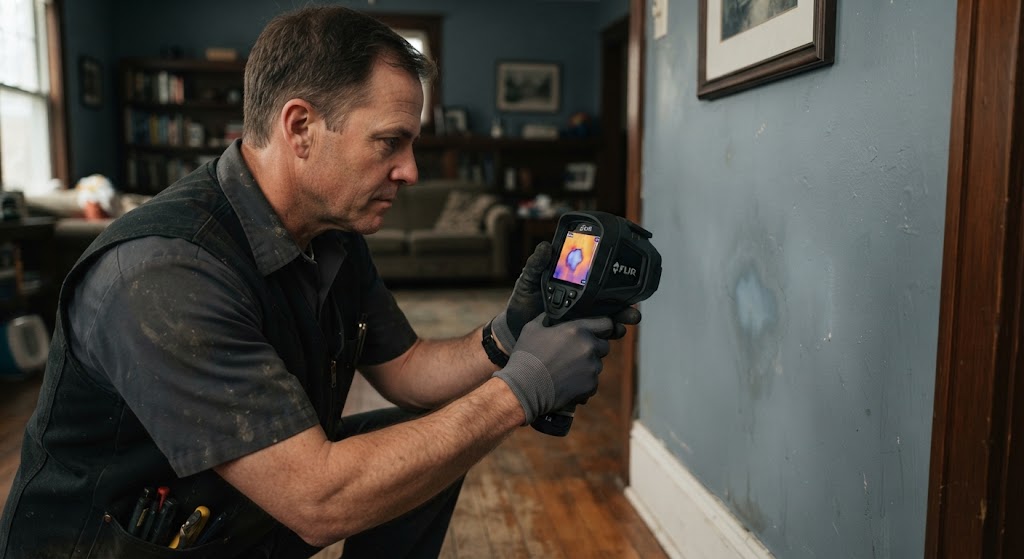
Instead of executing destructive exploratory demolition across multiple rooms, modern hidden water leak detection Freehold Township uses state-of-the-art non-invasive instrumentation to locate the origin point with laser precision.
Warning Signs of Hidden Leaks
Discolored patches, bubbling paint, or damp drywall along interior partition walls.
Persistent musty odors that linger despite continuous ventilation and cleaning.
Unexplained thermal variances or unexplained damp spots on hardwood and carpeting.
Audible hissing or dripping sounds behind bathroom tile or kitchen cabinetry.
Seeing Moisture Stains or Smelling Musty Odors?
Protect your home from mold proliferation. Talk directly with a Freehold Township leak technician today.
Advanced Non-Invasive Water Leak Detection Freehold Township NJ Process
Our systematic multi-stage diagnostic approach prevents guesswork and preserves your architectural finishes.
Pressure Differential Testing
We isolate hot and cold potable water loops, monitoring digital pressure gauges to verify that an active pressurized failure exists.
Thermal Infrared Profiling
High-resolution FLIR cameras scan building surfaces, mapping cool evaporative thermal patterns that reveal hidden moisture trails.
Acoustic Resonance Pinpointing
Sensitive acoustic listening probes filter ambient room noise to focus specifically on the high-frequency vibration of water escaping the pipe.
Surgical Access Blueprint
We mark the exact coordinate on the wall or ceiling, allowing your plumbing contractor to perform an isolated, single-stud bay repair.
What Happens After the Hidden Leak is Found
Once we pinpoint the exact breach coordinate, the path forward becomes straightforward and cost-controlled. Rather than paying for extensive drywall replacement and repainting across entire rooms, your plumber opens a small, surgical inspection opening directly over the damaged pipe.
Depending on the condition of the pipe material, repair options generally range from soldering a new copper sleeve to replacing localized sections with durable PEX piping. If widespread galvanic corrosion is identified throughout aged piping runs, our diagnostic findings help determine whether selective re-piping or targeted spot repairs offer the best long-term value.
In New Jersey, permanent plumbing repairs must be completed by an NJ licensed master plumber. Our comprehensive diagnostic mapping ensures your chosen contractor executes repairs swiftly with zero guesswork.
Cost Factors in Hidden Leak Detection
Accessibility: Leaks located behind tiled shower enclosures or multi-layer ceilings require specialized acoustic calibration compared to open drywall.
System Complexity: Properties with multi-zone manifolds, hydronic radiant heating loops, or finished basements require comprehensive isolation testing.
Secondary Damage Prevention: Fast diagnostic pinpointing eliminates exploratory tear-outs, saving thousands in structural restoration.
Common Hidden Leak Areas in Freehold Township
In two-story homes in West Freehold and residential neighborhoods near Route 537, second-floor master bathrooms and laundry rooms are frequent sources of hidden water intrusion. Vibration from washing machine supply lines and expansion-contraction cycles on hot water piping often produce hairline stress cracks near copper elbow joints.
To prevent catastrophic failures, consider installing an automatic whole-house water shut-off sensor on your main supply valve. Periodically inspect flexible supply lines under sinks and behind toilets, replacing braided hoses every five to seven years.
When water begins seeping through ceiling sheetrock or down foundation walls, treat it as an urgent priority to prevent structural mold colonization.
When Is It An Emergency?
Water actively dripping through light fixtures or finished ceiling drywall.
Rapidly expanding water stains accompanied by peeling paint or swelling trim.
The water meter spinning rapidly even when all plumbing valves are closed.
Call our emergency response line at (201) 510-1615 immediately if active flooding occurs.
Hidden Water Leak FAQs
Common questions regarding locating concealed plumbing leaks in Freehold Township homes.
Stop Hidden Leaks Before Structural Damage Spreads
Schedule non-invasive diagnostic locating with Freehold Township's trusted specialists.